Hello and welcome to the Stone News, a newsletter where we discuss every three months the most recent and relevant studies in stone disease. Suscribe now |
|
|
|
|---|
|
| | Dear Stone Fans. Kidney stone care is rapidly moving beyond stone removal toward smarter prevention, safer surgery, and novel biologic solutions. Recent expert updates highlight that long-term success depends on individualized medical prevention, centered on potassium citrate, selective use of thiazides, and promising adjuncts like phytate and theobromine, supported by close monitoring and patient adherence. At the same time, strict application of ALARA principles has shown that radiation exposure during stone surgery can be dramatically reduced without affecting outcomes. Looking to the future, groundbreaking research on engineered gut bacteria capable of degrading intestinal oxalate offers a new way to target stone disease.
Together, these advances reflect a clear shift toward more comprehensive, patient-centered, and forward-looking stone management.
Please enjoy this Winter edition of Stone News. |
|  |
|
|
|---|
|
| | Management of urinary stones by experts in stone disease (ESD 2025) Papatsoris A. et al. Arch Ital Urol Androl. 2025. |
| |
|---|
|
The ESD 2025 expert update emphasizes that preventing stone recurrence hinges on pharmacologic modification of urine chemistry, used alongside lifestyle changes, and that adherence and monitoring determine success. The cornerstone medication class is alkaline citrate salts, especially potassium citrate, because they raise urinary citrate and alkalinize urine, helping inhibit crystal formation and supporting prevention in patients with hypocitraturia and common calcium stone risk profiles; they also stress that dosing must be individualized with regular urine pH checks to avoid over-alkalinization (≈≥7.5), which can increase calcium phosphate stone risk, and with electrolyte monitoring to reduce hyperkalemia risk in CKD or those on potassium-sparing drugs.
For hypercalciuria, thiazide diuretics remain an important option but are limited by tolerability (notably hypokalemia-related symptoms and other less common adverse effects), making patient education and side-effect mitigation key.
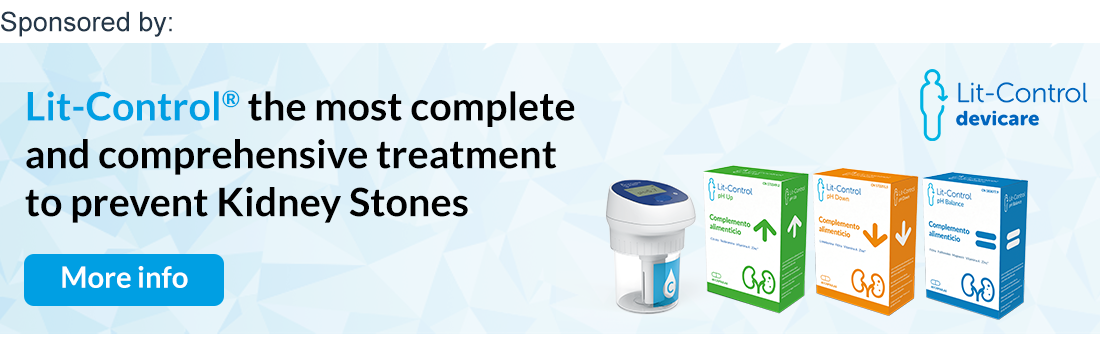
The article highlights emerging adjuncts that may expand the prevention importantly, combining theobromine with potassium citrate (Lit-Control® pH Up) is proposed as a way to improve urinary crystallization conditions while potentially allowing lower citrate doses, thereby reducing the risk of excessive alkalinization and hyperkalemia.
Finally, the experts underline that long-term outcomes depend heavily on treatment adherence, and suggest that practical supports, like home urine pH tracking (Lit-Control® pH Meter) and smartphone tools (myLit-Control® App) that prompt hydration, diet, and medication compliance, can meaningfully improve real-world prevention. |
|
|
|
|---|
|
| | Maximizing safety in stone disease: the impact of strict As Low As Reasonably Achievable (ALARA) principle adherence on radiation exposure and clinical outcomes De Coninck V. et al. WJU. 2025. |
| |
|---|
|
This study evaluates the real-world impact of strict adherence to the ALARA (As Low As Reasonably Achievable) principle on radiation exposure and clinical outcomes in endourological stone procedures, addressing growing concerns about cumulative ionizing radiation risk in urolithiasis care. In a retrospective analysis of 755 consecutive patients undergoing PCNL, URS, SWL, and JJ insertion or replacement by a single surgeon over five years, outcomes before and after implementation of strict ALARA protocols were compared.
After formal radiation-safety retraining, the ALARA group employed lower fluoroscopy pulse rates, tighter beam collimation, optimized source-to-skin and detector distances, and reduced reliance on contrast and access sheaths. Strict ALARA adherence resulted in dramatic reductions in radiation exposure, with dose area product (DAP) reduced by 63–95% and fluoroscopy time reduced by 18–65% across all procedures, without any compromise in stone-free rates, complication rates, or operative time, and operative time was in fact shorter for PCNL and URS. URS demonstrated the lowest radiation burden overall, largely due to contrast avoidance and limited UAS use.
Importantly, observed radiation levels were substantially lower than previously published reference standards. This study provides strong evidence that radiation exposure in endourology can be reduced by an order of magnitude through systematic ALARA implementation without sacrificing efficacy or safety. The findings reinforce the need for broader education, protocol standardization, and prospective validation, supporting ALARA as a critical quality and safety benchmark in modern stone surgery. |
|
|
|
|---|
|
| | Controlled Colonization of the Human Gut With a Genetically Engineered Microbial Therapeutic. Whitaker WR, et al. Science. 2025. |
| |
|---|
|
This study shows that genetically engineered gut bacteria can safely colonize humans and actively degrade intestinal oxalate, reducing urinary oxalate and kidney-stone risk in animal models and showing promising (though inconsistent) effects in humans with enteric hyperoxaluria. By engineering Phocaeicola vulgatus to metabolize oxalate and survive only when patients ingest porphyran (a seaweed fiber), researchers demonstrated controllable, diet-dependent colonization in healthy volunteers, but found reduced stability and genetic exchange in post-bariatric patients, limiting efficacy.
Clinically, the work reinforces that the gut is a key therapeutic target for calcium oxalate stones, validating current strategies such as calcium with meals, magnesium or/and as adjunctive phytate therapy (Lit-Control® pH Balance), low-oxalate diet and selective use of cholestyramine in enteric hyperoxaluria. It also explains why standard probiotics have limited benefit and suggests future engineered microbial or targeted prebiotic therapies could meaningfully reduce stone recurrence once stability and safety challenges are solved. |
|
|
|
|---|
|
| | | | Av. Generalitat, 163-167 Sant Cugat Green Building, 08174, Sant Cugat del Vallès, Barcelona |
| | | This email has been sent to amartinez@devicare.com. | | |
| You received this email because you have subscribed to our newsletter. |
| | | | |
|
|
|---|
|
|